Pocket Tales book series presenting works of prominent classical authors in Persian
“Pocket Tales” book series presenting works of prominent classical authors in Persian
TEHRAN – Amir Kabir Publications in Tehran is publishing long stories and short novels by prominent classical authors in pocket-sized editions in Persian.
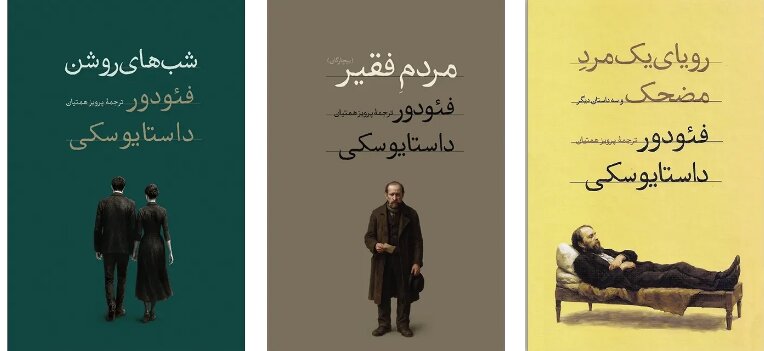
The publication of this new collection titled “Pocket Tales” has begun with stories by the Russian classical author Fyodor Dostoevsky, ISNA reported.
The first three titles in the series are “White Nights,” “Poor Folk,” and “The Dream of a Ridiculous Man and Three Other Stories,” all translated by Parviz Hemmatian.
These works had previously been published by Amir Kabir in older formats and editions, and are now reissued as part of the “Pocket Tales” series.
“White Nights” is a short story by Fyodor Dostoevsky, originally published in 1848, early in the writer's career.
Like many of Dostoevsky's stories, “White Nights” is told in the first person by a nameless narrator. The narrator is a young man living in Saint Petersburg who suffers from loneliness. He gets to know and falls in love with a young woman, but the love remains unrequited as the woman misses her lover, with whom she is finally reunited.
“Poor Folk,” sometimes translated as “Poor People,” is the first novel by Dostoevsky, written over the span of nine months between 1844 and 1845.
Inspired by the works of Gogol, Pushkin, and Karamzin, as well as English and French authors, “Poor Folk” is written in the form of letters between the two main characters, Makar Devushkin and Varvara Dobroselova, who are poor third cousins twice removed.
The novel showcases the life of poor people, their relationship with rich people, and poverty in general, all common themes of literary naturalism. A deep but odd friendship develops between them until Dobroselova loses her interest in literature, and later in communicating with Devushkin after a rich widower Mr. Bykov proposes to her. Devushkin, a prototype of the clerk found in many works of naturalistic literature at that time, retains his sentimental characteristics; Dobroselova abandons art, while Devushkin cannot live without literature.
“The Dream of a Ridiculous Man” is a short story by Fyodor Dostoevsky. It chronicles the experiences of a man who decides that there is nothing of any value in the world. Slipping into nihilism with “terrible anguish,” he is determined to commit suicide. However, after a chance encounter with a young girl, he begins an inner journey that re-instills a love for his fellow man.
According to literary theorist and Dostoevsky scholar Mikhail Bakhtin, “The Dream of a Ridiculous Man” is a modern manifestation of the ancient literary genre Menippean satire, and touches on almost all the themes characteristic of Dostoevsky's large-scale works.
Fyodor Dostoevsky[a][b] (1821 – 1881) was a Russian philosopher, novelist, short story writer, essayist, and journalist. He is regarded as one of the greatest novelists in both Russian and world literature, and many of his works are considered highly influential masterpieces.
Dostoevsky's literary works explore the human condition in the troubled political, social, and spiritual atmospheres of 19th-century Russia, and engage with a variety of philosophical and religious themes. His most acclaimed novels include “Crime and Punishment” (1866), “The Idiot” (1869), “Demons” (1872), “The Adolescent” (1875), and “The Brothers Karamazov” (1880). His “Notes from Underground,” a novella published in 1864, is considered one of the first works of existentialist literature.
“The Gods Are Athirst” by Anatole France and “Hadji Murat” by Leo Tolstoy are the next titles in the “Pocket Tales” series and are currently in print, to be released to the book market soon.
The historical novel “The Gods Are Athirst” (also translated as “The Gods Are Thirsty” or “The Gods Will Have Blood”) was first published in 1912. It is set in Paris in 1793–1794, during the French Revolution, particularly during the Reign of Terror, and explores the impact of revolutionary fervor on individuals and society.
The novel follows the life of Évariste Gamelin, a young, idealistic artist who becomes a fervent supporter of the Revolution. He is appointed as a juror on the Revolutionary Tribunal, where he is tasked with passing judgment on those accused of being enemies of the Revolution.
As Gamelin becomes increasingly consumed by his revolutionary zeal, he transforms from a compassionate artist into a ruthless enforcer of revolutionary justice.
Through Gamelin's story, Anatole France examines themes of fanaticism, justice, and the corrupting influence of power. The novel critiques the extremism and violence of the Revolution, illustrating how noble ideals can lead to tragic outcomes when taken to extremes.
France's portrayal of the period is marked by his characteristic wit and irony, providing a nuanced and critical perspective on the events and ideologies of the time.
“Hadji Murat” is a novella written by Tolstoy from 1896 to 1904, though it was published posthumously in 1912.
The final work of Tolstoy, “Hadji Murat” is about an Avar rebel commander who seeks personal revenge and forges an uneasy alliance with the Russians who he had previously been fighting.
According to Amir Kabir Publications, the number of titles in the “Pocket Tales” is expected to reach 10 by the upcoming Tehran International Book Fair in May.
SS/
source: tehrantimes.com