Trump trapped in a conflict with Iran
Trump trapped in a conflict with Iran
Farhikhtegan analyzed Trump’s speech at the UN. According to the paper, Trump’s speech revolved around one central theme: explaining why he has failed against Iran. The US President, who knows he is highly likely to lose the midterm elections, claimed the elections do not matter to him.
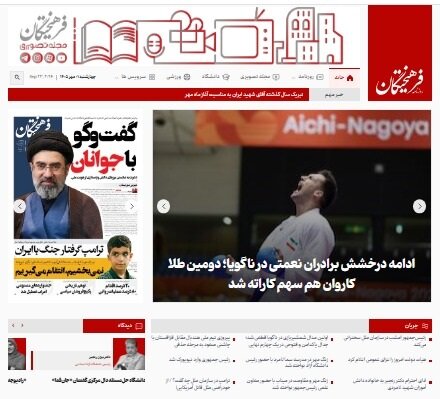
Although he described the United States as the most powerful country in the world and its military as the greatest in history, he pleaded — not with allies but with all governments — to join economic sanctions against Iran. The paper notes that Trump, who has repeatedly offered different reasons for conflict with Iran, claimed he prevented Tehran from developing missiles capable of reaching Europe. Yet Iran has been capable of achieving such range for decades, but has limited its missile program to 2,000 kilometers based on its own policies. Interestingly, Trump has been unable to stop Iran’s strikes against American bases and vessels, yet boasts to Europe about supposed achievements.
Jam-e-Jam: Opportunities for Iran’s delegation at the United Nations
Jam-e-Jam, in a commentary, referred to Iran’s presence at the UN General Assembly and wrote: Given the intense narrative-building surrounding current tensions between Iran and the United States, the presence of the Iranian delegation at the Assembly can naturally be significant. Considering the special circumstances the country is facing — including maritime encirclement, US sanctions pressure, and clear violations of international law committed against Iran — this is an appropriate opportunity for these issues to be discussed in an international forum and for Iran’s positions to be properly explained. Therefore, attending the UN General Assembly is a valuable opportunity for Iran, especially since the country is subject to heavy media censorship driven by extensive Zionist lobbying. Despite US obstruction and restrictions on Iranian journalists covering the Assembly, the presence of the President, the Foreign Minister, and the accompanying delegation can help advance the narrative favored by the Islamic Republic.
Iran: The UN as an opportunity to clarify Iran’s positions
Abbas Salimi-Namin, a researcher of contemporary history, told the Iran newspaper that Iran must use international opportunities to clarify the positions of the Islamic Republic. He described the President’s presence at the UN General Assembly as a chance to express Iran’s views and explain the foundations of its positions. In his view, one should not be worried about the President speaking on this platform or interpret it as a sign of weakness, because the way issues are presented and adherence to principles can clarify Iran’s stance before representatives of various countries. Pezeshkian must act in a way that avoids any impression of weakness. Although US influence in some international institutions is a notable reality, this influence should not lead Iran to withdraw from participation. If Iran’s positions and arguments are properly articulated, it may even expose the extent of US influence to global public opinion and help weaken it.
Ham-Mihan: Do not give the enemy a pretext
In an interview with Ham-Mihan, former MP Heshmatollah Falahatpisheh discussed the three‑urgency proposal for Iran’s withdrawal from the Nuclear Non-Proliferation Treaty (NPT). He argued that some parliamentary proposals are always one step behind reality. Iran was a country that could have reached a nuclear weapon, but such a path was never part of national policy. Now that many of Iran’s nuclear programs have been sacrificed due to what he called a major lie about Iran’s nuclear issue, such proposals not only fail to help Iran but also assist the United States in forming a coalition against Iran. Withdrawal from the NPT implies that Iran intends to pursue a military nuclear program, but since such a program does not exist, the only effect of this urgent proposal would be to make it easier for figures like Trump — who seek global consensus against Iran — to achieve their goal.
Sobh-e-No: Iran’s role in the emerging regional order
Sobh-e-No discussed the need for Iran to help shape a new regional order in an interview with Dr. Mohammad-Bagher Khorramshad, a political sociologist. He explained that the six southern Persian Gulf states formed the Persian Gulf Cooperation Council to design a regional order that excludes Iran. If a regional order is to include all countries, three additional states must be added to the six southern Persian Gulf countries: Iran, Iraq, and Yemen. Iran must be recognized as a decisive actor in the future regional order. Current events show that Iran cannot be removed from regional security calculations. This war has revealed a new generation of warfare. Iran, facing two of the world’s powerful militaries, managed to defend its position — a fact that will inevitably influence future regional order calculations. Therefore, any scenario for the region’s future must consider Iran as a key actor while also aiming for a regional security structure that is as self-sustaining as possible.
source: tehrantimes.com