The empty chairs of Minab
The empty chairs of Minab
MASHHAD — The courtyard was full before the first bell rang. Thousands of children in freshly pressed uniforms stood under a sky that felt too ordinary for the day. They hadn't gathered to start a new school year.
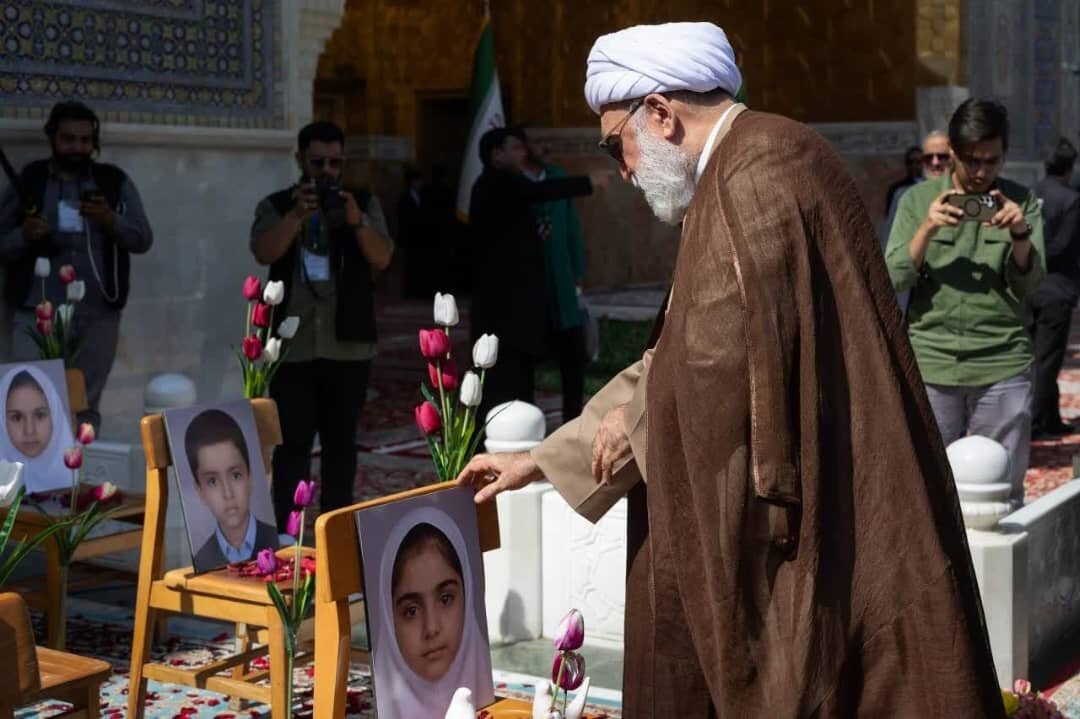
They'd come to remember children who never got to.
Today, in the Islami Inqilab Courtyard of the Imam Reza shrine in Mashhad, thousands of schoolchildren gathered to pay tribute to the children of Minab and to honor the martyrdom of Supreme Leader Ayatollah Seyyed Ali Khamenei. Beneath the golden dome, the children stood together in a ceremony that turned the first day of school into a moment of remembrance, mourning and defiance.
“Death to America. Death to Israel.” The chant rolled through the crowd, familiar and practiced. In another setting it might have sounded routine. Here it sounded like grief that had run out of gentler words.
They were remembering Minab. On February 28, American and Israeli forces launched their war against Iran. The Shajareh Tayyebeh School in Minab was struck as classes were underway. UNICEF reported that 168 schoolchildren and teachers were killed at the school; for the families left behind, the number is not a statistic. It is a list of names nobody wants to finish reading.
And now there is another finding that cannot simply be pushed aside. On Thursday, the UN Independent International Fact-Finding Mission on Iran said it had reasonable grounds to believe the United States was behind the February strikes, including the attack on the Minab school, and concluded that both constituted war crimes. The mission said the Minab strike was an indiscriminate attack on civilian infrastructure and found that US forces failed to take feasible steps to verify that the school was a military objective.
That finding changes the question. This is no longer only about what Iran says happened. A UN-mandated investigation has now placed responsibility and international humanitarian law at the center of the discussion. The issue is no longer simply whether the world noticed the children of Minab. It is whether the world will demand accountability for their deaths.
In most of Iran, the first day back to school looks the same every year — new shoes still stiff from the box, the smell of fresh notebooks, kids nervously finding their classrooms. In Minab this year, that ordinary morning didn't come. Beds stayed made. Breakfast went cold on the table. No one packed a lunch, because there was no one to pack it for. The school gates opened onto absence instead of noise.
That's the part of war nobody puts in a press briefing. Officials in Washington and Tel Aviv talk about targets and deterrence, calculations made somewhere the rest of us never see. The language is built to sound controlled, almost administrative. But a missile doesn't know any of that. It only knows what's in front of it — a wall, a rooftop, a room full of children doing their morning lesson. When one hit Shajareh Tayyebeh, it did not pause to ask whether the room below was teaching arithmetic or reciting a poem. It just went off.
The children who gathered under the golden dome of the Imam Reza shrine understood something their own government has said for years and that, for once, felt true instead of rehearsed: in Iran, war isn't theoretical. It is a subject with a body count that includes people you knew.
The dead were not abstractions. They were girls who helped their mothers cook on weekends, boys who played street football until the light gave out, children who split a pencil in half so a friend would not have to ask the teacher for one. Teachers stayed late for a child stuck on a problem. They had names, routines, small arguments with siblings, plans for the weekend — and then they didn't, all at once.
The first day of school is supposed to be a beginning. In Minab it became something else — a reminder of everything that was cut short. Somewhere else in the country, buses were pulling up outside schools and children were arguing over seats. In Minab, families were walking to a cemetery instead, carrying flowers because there was nothing else left to bring.
Under the dome, the chant came back around: “Death to America. Death to Israel.”
It is easy to hear only the slogan. Underneath it is a generation that has grown up absorbing decisions made in rooms they will never enter. To these children, the war is not a map with arrows on it. It is a photograph taped to a wall at home. It is a family that still remembers the child who should have walked through the door.
This is where the official language runs out. A government can call a strike strategic. A general can call a target legitimate. None of that answers the question a parent actually has, which is simpler and harder: Why didn't my child come home from school?
The UN finding makes that question even harder to dismiss. The mission said the United States failed to take feasible steps to verify that the Minab school was a military objective and concluded that the attack amounted to a war crime. The US government has disputed such findings and has not publicly released the full results of its own investigation.
So accountability cannot stop at statements of regret or carefully chosen words. If international law means anything, civilian lives cannot become secondary simply because the bombs were dropped by a powerful state. A school does not become a military target because someone, somewhere, claimed otherwise. The burden is on those who order and conduct an attack to distinguish civilians from military objectives.
Behind all the legal language sits a question that is painfully human: Who will answer the parents of Minab?
Under the golden dome, the children did not let the memory disappear. They stood where their classmates could not. They remembered the dead on the very morning when their own school year was beginning. For one morning, grief became something closer to a demand — that the world look directly at what happened in Minab instead of finding another reason to look away.
And today, those children carried another message beyond the shrine. They carried it home with them: resistance is in our blood. We may be ready to sacrifice, but we are not ready to surrender.
The chairs are still empty. But Minab has not gone quiet. The names are still spoken, the families have not stopped asking, and the questions have already traveled beyond Iran's borders.
source: tehrantimes.com